
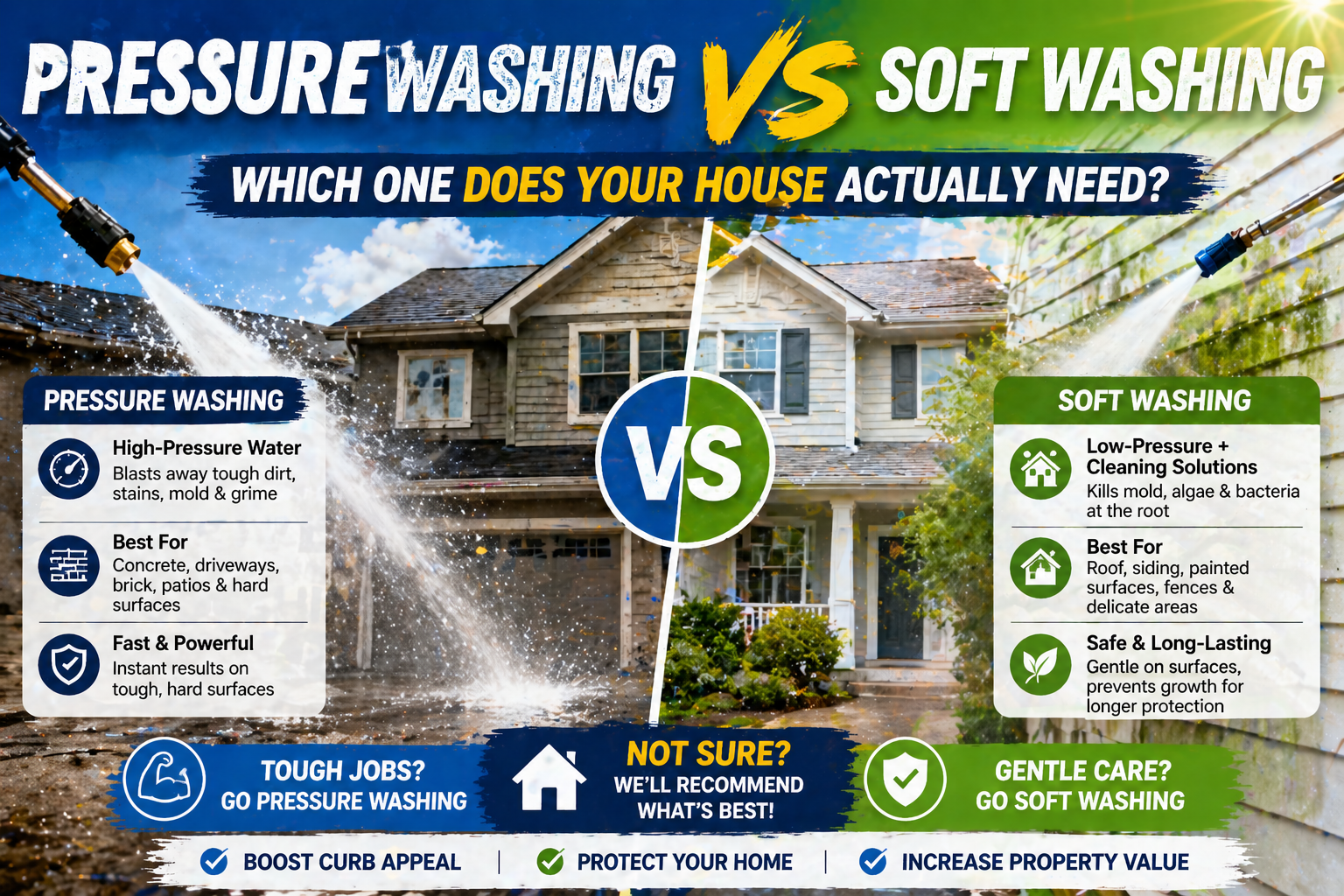
Almost everyone who calls us starts the same way. "Hey mate, can I get a quote for pressure washing my house?" Fair enough — that's the term everyone knows. But here's the part that catches most homeowners off guard: around 70% of the surfaces you actually want cleaned on your home should not be pressure washed. They should be soft washed.
It's not a marketing gimmick or an upsell. It's a real difference in method, pressure, and chemistry, and getting it wrong is how you end up with cracked roof tiles, stripped paint, water forced behind your render, or a "clean" that's covered in mould again by spring. This guide breaks down the difference in plain English so you know exactly what your home needs — and why.
What is pressure washing?
Pressure washing is the one everyone pictures. A high-powered machine pushes water through a narrow nozzle at somewhere between 2,000 and 4,000+ PSI. That's a serious amount of force. At that pressure, water alone can strip grime, oil, moss, gum, and ground-in dirt off hard, durable surfaces.
The trade-off is simple. High pressure is brilliant at cleaning tough stuff, but it's way too aggressive for anything fragile. A pressure washer doesn't know the difference between concrete and a painted weatherboard — it just blasts. Which is why pressure washing belongs on driveways, footpaths, commercial slabs, and heavy industrial gear. Not your roof. Not your render. Not your house.
What is soft washing?
Soft washing is the opposite approach. Instead of relying on brute force, it uses low pressure — usually around 300 to 500 PSI, about the same as a garden hose — combined with a purpose-built soft washing system that applies biodegradable cleaning solutions and a mould and algae biocide.
The chemistry does the cleaning, not the pressure. Soft washing chemicals break down mould, algae, lichen, and bacteria at the spore level, which is the stuff no amount of pressure can permanently fix. Then the solution is rinsed off gently so the surface underneath is untouched.
That's why soft washing is the right call for almost everything on the outside of a typical Sunshine Coast home. Roofs (both tile and Colorbond), painted render, fibro, weatherboard, brick, Colorbond fences, eaves, and the exterior of your gutters all need the low-pressure, chemistry-led approach. Blast them with a pressure washer and you're creating damage the clean was supposed to prevent.
When to use pressure washing
Pressure washing is the right tool when the surface is hard, durable, and flat. Use it for:
- Concrete driveways and footpaths
- Commercial slabs and loading bays
- Hardwood decks in good condition (carefully, with the right tip)
- Heavy machinery and industrial equipment
- Stormwater drains and heavy oil stains
- Paver areas and pool deck concrete
For driveways and footpaths we almost always pair the pressure washer with a flat surface cleaner, which gives an even, streak-free finish instead of the tiger-stripe mess you get from a wand alone.
When to use soft washing
Soft washing is the right tool for almost everything else on your home. Use it for:
- Roofs (both tile and Colorbond)
- Painted render and rendered walls
- Fibro and weatherboard
- Brick exteriors
- Colorbond fences and gates
- Eaves, fascias, and exterior gutters
- Solar panels
- Pool surrounds with painted or coated surfaces
- Anything with paint, coating, or sealant
If a surface is painted, coated, porous, or even slightly fragile, it's a soft wash job. Full stop.
Pressure washing vs soft washing: side-by-side
| Factor | Pressure Washing | Soft Washing |
|---|---|---|
| Pressure level | 2,000–4,000+ PSI | 300–500 PSI (garden-hose level) |
| Method | High-pressure water blast | Low pressure + biodegradable detergent + biocide |
| Best for | Concrete, footpaths, commercial slabs | Roofs, render, brick, weatherboard, fences, solar, eaves |
| Main risk | Surface damage, stripped paint, forced water ingress | Minimal when applied by a trained operator |
| Lasting result | Surface-level clean, mould often returns in months | Kills mould and algae at the spore level — lasts far longer |
Why "just pressure wash everything" is the #1 mistake homeowners make on the Sunshine Coast
We're based on the Sunshine Coast and cover North Brisbane down to South Gympie. Between the humidity, the sea air, the rain, and the tree canopy, this region is a perfect breeding ground for mould, lichen, and black algae. Which is exactly why the "hit it with the highest PSI you can find" approach does so much damage up here.
A few of the jobs we regularly get called out to fix:
- Cracked roof tiles and lifted ridge caps from high-pressure wands that were never designed to be pointed at a roof
- Water forced behind render through hairline cracks, causing internal moisture and rot you won't see for months
- Stripped paint on weatherboard, fibro, render, and fences
- Etched, permanent wand patterns on concrete where the operator held the tip too close for too long
- Mould returning in six months because high-pressure water removes the surface stain but leaves the spores alive underneath
The last one is the biggest. Without a proper soft washing system and biocide, you're just doing a very expensive visual clean. The mould comes straight back because you never killed it.
A real-world example: cleaning a typical Sunshine Coast 3-bedroom home
When we roll up to a standard three-bedroom house for a full exterior clean, here's how we actually break it down. Different surfaces, different methods, one job.
- Roof (tile or Colorbond) → soft wash with a mould and algae pre-treatment
- Walls and render → soft wash
- Driveway and footpaths → pressure wash with a surface cleaner
- Fences (Colorbond or timber) → soft wash
- Gutters → manual scoop for leaves, soft wash on the exterior
- Solar panels → soft wash using low pressure, deionised water where possible to avoid mineral spotting
- Eaves and fascias → soft wash
One house, one visit, five or six different cleaning approaches. That's what picking the right method for each surface actually looks like — and it's why we don't quote "pressure washing" as a single flat rate. We quote the surfaces, and we use the method each one needs.
FAQ
For roofs, render, brick, fences, and anything painted or coated — soft washing is more effective, not less. The biocide kills mould and algae at the spore level, which pressure alone can't do. For heavy concrete stains or oil, pressure washing wins because chemistry isn't enough on its own.
Yes, significantly. Because soft washing kills the organic growth at the spore level instead of just blasting the surface, regrowth is much slower. We typically see soft-washed roofs and render stay clean for two to four times longer than high-pressure cleans on the same surfaces.
Not when it's done properly. We pre-wet gardens, rinse down during the job, and use biodegradable soft washing chemicals at the right dilution. We've soft-washed hundreds of homes around the Sunshine Coast and looking after your garden beds is part of the process — not an afterthought.
Honestly, we'd recommend against it. Roof work has real fall risk, and the biocides used in a proper soft washing system need to be mixed, applied, and rinsed correctly to be safe and effective. Cheap DIY roof products rarely contain the right chemistry, so you'll end up doing the work twice.
The bottom line
Pressure washing and soft washing aren't competing services — they're different tools for different jobs. A good operator uses both, and knows which one belongs on which surface.
We'll tell you which one your home actually needs before we quote — not just blast everything.
Want an honest quote — not just a blast?
We'll walk every surface, tell you what it actually needs, and price it the right way.
- Get a Free Quote -